Home → The Back Wall & diving
The Back Wall & diving
Every snorkeler sees Molokini's calm inside. Divers know its other face: the crater's outer wall, where the reef falls away roughly 350 feet into open ocean and the water is blue all the way down. Two very different dives share one crater — here's both, honestly graded.
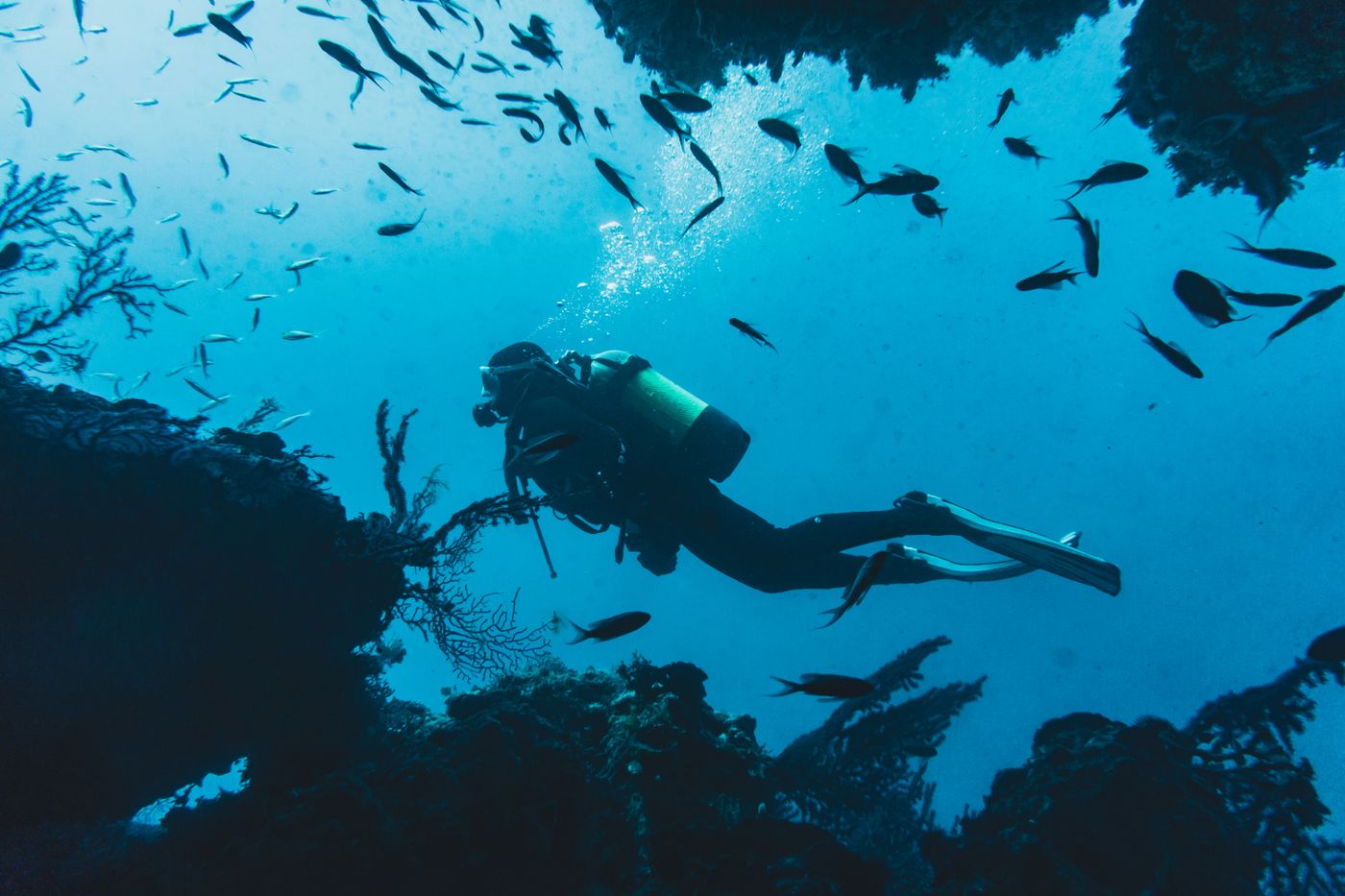
The Back Wall
The crescent you see from a boat is the top of the crater rim. On the outside, that rim doesn't slope — it drops, nearly vertically, about 350 feet to the channel floor. Diving it means descending along a wall of volcanic rock and coral into water so clear you can see the wall curving away in both directions, with the open Pacific behind you: the realm of eagle rays, white-tip reef sharks, big jacks, and the occasional manta passing out of the blue.
It is a drift dive — the boat drops you up-current and follows your bubbles as the wall carries you along — and it is unambiguously an advanced dive: no bottom within recreational limits, open-ocean exposure, and depth that arrives fast if you're not watching it. Operators set real gates: certification, recent diving (the charter below requires a dive within the last two years), and enough logged experience to hold buoyancy beside a wall with no floor. If that's you, it's one of the signature dives of Hawaiʻi. If it's not yet you, it will still be there — build to it.
The inside-crater dives
The same moorings the snorkel boats use serve divers too, and the inside is a different world: coral gardens and sand flats in 30–60 feet, turtles at cleaning stations, reef sharks resting on the sand, and none of the Back Wall's exposure. First boat dives, refresher dives, and photographers who want time instead of adrenaline all belong here. Several charters pair one of each — a Back Wall drift and an inside or coastal second tank — weather deciding the order.
2-tank Molokini Back Wall drift dive
The dedicated Back Wall trip: a small dive boat (a dozen divers, max) out of the Kihei Boat Ramp at first light, two tanks that may pair the Back Wall drift with a second site such as the St. Anthony wreck, conditions deciding. The requirements are stated plainly and enforced: you must have dived within the past two years, provide your certification and recent-dive details at booking, and gear sizing info in advance — full gear rental is available for a fee.
Check dates & book on ViatorThe Haleakalā rule: divers cannot go to altitude after diving — this operator's cutoff is 500 feet for 24 hours, and standard guidance is stricter. Haleakalā's summit is 10,023 feet. Never pair a dive morning with a Haleakalā afternoon — put the mountain on a different day. It's the one scheduling mistake at Molokini with real consequences.
Not a diver? You can still see the wall
One small-group raft snorkel runs the crater's rim from the surface — inside crescent, a look over the Back Wall's top edge, and Turtle Town in a single trip. It's not the wall dive, and it doesn't pretend to be; it's the closest a snorkeler gets. It's on the day-trips & combos page.